If you’ve been scrolling through rug-making videos, you’ve probably noticed that people use “tufting,” “weaving” and “punch needle” as if they mean the same thing. They don’t.
They’re three different ways to make textiles, with different tools, different results, different learning curves and very different timelines.
Pick the wrong one and you can end up with a loom in your living room and a half-finished placemat six months later. Pick the right one and you could walk out with a finished rug in an afternoon.
This guide covers:
How each method actually works
How they compare on speed, cost, durability and difficulty
Which one to try first
We run a rug tufting studio in North York, so we’ll be upfront: tufting is what we teach. We’ll also tell you honestly where weaving or punch needle might suit you better.
The short answer
Rug tufting
Punch needle
Rug weaving
How the yarn goes in
A tufting gun shoots yarn through a stretched cloth
A hand-held hollow needle pushes yarn through cloth
Threads are interlaced on a loom, over and under
Tool
Electric or pneumatic tufting gun and a frame
Punch needle and a hoop or frame
A loom, shuttle, beater and more
Pile
Cut pile or loop pile, or a mix
Loop pile (some tools make a cut look)
Flat (no pile) or knotted pile
Speed
Fast: a rug in hours
Slow: small pieces take hours to days
Slowest: days to months
Best for beginners?
Yes, results come quickly
Yes for small pieces
Takes the most learning
Best for
Bold shapes, logos, art rugs
Detail, small pieces, wall art
Durable, traditional, patterned rugs
If you want a finished, plush rug fast, tufting is the usual choice. If you want something portable and cheap to start, punch needle. If you want the traditional, long-lasting craft and don’t mind the time, weaving.
The rest of this guide explains why.
Rug tufting: how it works
Rug tufting is the method behind most of the colourful, plush, custom rugs you see online right now.
The process
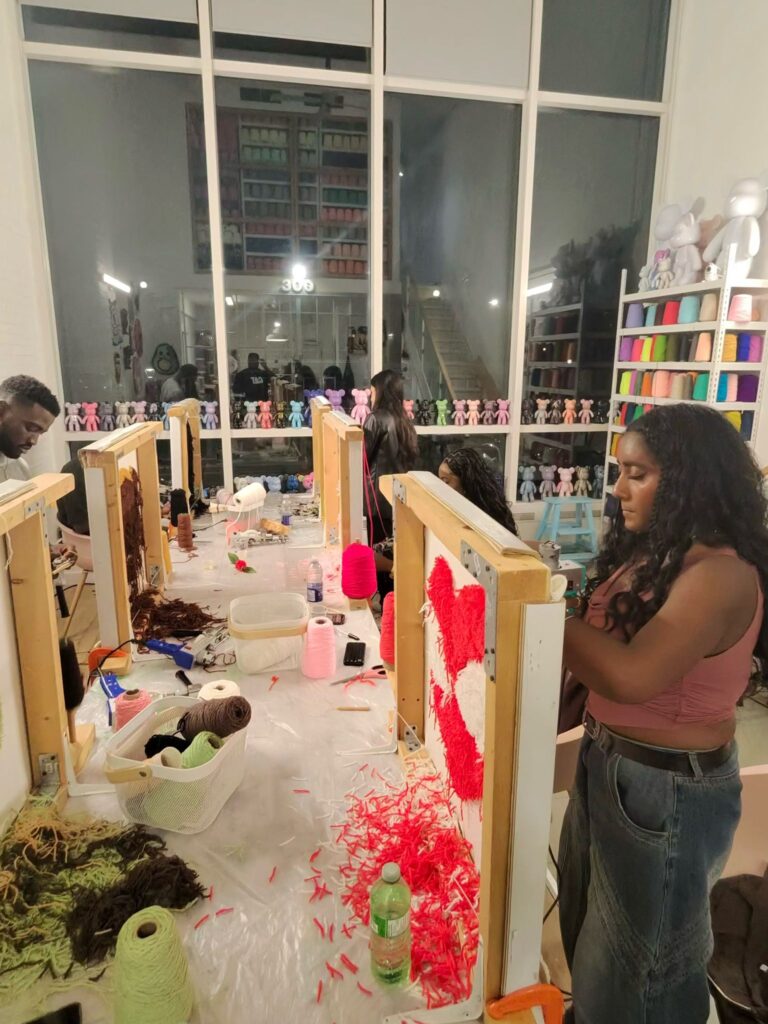
Stretch the base fabric. A woven backing cloth (often called primary tufting cloth or monk’s cloth) is pulled tightly onto a frame so it’s as taut as a drum.
Draw the design. You trace or draw your pattern onto the cloth. Because you work from the back, the design is usually mirrored.
Tuft with the gun. A tufting gun pushes yarn through the cloth. The yarn forms either loops (loop pile) or is cut as it goes (cut pile), depending on the gun and setting. You fill in the design like colouring in, working outline first, then the fill.
Secure the back. Once the tufting is done, a layer of adhesive is applied to the back to lock the yarn in place. A secondary backing cloth is often added for extra stability.
Finish. The rug is trimmed, and shaped with shears so it’s neat. Edges can be finished with binding or carved around the design.
Why people love it
Speed. A gun can do in minutes what takes hours with hand tools. Many beginners finish a small rug in a single session.
Bold, graphic results. Tufting is brilliant for big colour blocks, shapes, cartoons, logos and abstract designs.
Texture. You can mix cut and loop pile in one piece, carve edges and create dimension.
Forgiving. If you make a mistake, you can pull yarn out and redo that area.
The trade-offs
Equipment. A tufting gun is the biggest expense if you want to do it at home. See our tufting gun guide.
It’s physical. The frame, the gun and standing for a long time add up.
It’s loud and messy. Loose yarn bits go everywhere.
Durability depends on the backing. A tufted rug is held by adhesive and backing rather than by woven structure, so how well it’s made matters. We cover that in the durability section below.
Punch needle is the hand-powered cousin of tufting. It looks similar on the surface (loops of yarn standing up from a fabric) but it works differently.
The process
Stretch the fabric. A fabric such as monk’s cloth or weaver’s cloth is stretched tightly in a hoop or on a frame.
Transfer the design. You draw the pattern on the fabric.
Punch the yarn. A hollow needle with yarn threaded through it is pushed into the fabric and pulled back out, leaving a loop. You repeat this stitch after stitch. Depending on the type of needle, the loops form on one side of the fabric, and the design is often drawn mirrored so it reads correctly on the finished side. Follow the instructions for your specific needle.
Finish. The piece is secured with glue on the back, trimmed if needed and finished.
Why people love it
Portable and cheap. All you need is a needle, a hoop, fabric and yarn. You can punch needle on the couch.
Detail. You control each stitch, so fine lines and small shapes are easier than with a gun.
Quiet and low-stress. It’s a meditative, relaxing craft.
Great for small projects. Coasters, patches, wall hangings, small mats and pillow fronts.
The trade-offs
Slow. Covering a large area stitch by stitch takes a long time. A rug-sized project is a serious commitment.
Hand fatigue. Repetitive motion can tire your hand and wrist.
Mostly loops. Standard punch needle makes loop pile. A cut-pile look usually needs extra steps.
Less suited to large rugs. It’s possible, but it’s not the efficient way to do it.
How is punch needle different from tufting?
Think of a tufting gun as a motorized punch needle. Both push yarn through fabric from one side, and both form loops. The gun does it hundreds of times faster, and it can also cut the loops. That’s why tufting suits rugs and punch needle suits small, detailed pieces.
Rug weaving: how it works
Weaving is a different category. In tufting and punch needle, yarn is pushed into an existing cloth. In weaving, the yarn is the cloth.
The process
Warp the loom. Long threads (the warp) are stretched tight across a loom, like the strings on a harp.
Weave the weft. A second set of threads (the weft) is passed over and under the warp, row after row, and pressed down with a beater to build the fabric.
Choose a structure. You can weave a flatweave (a rug with no pile, like a kilim or dhurrie), or build a pile rug by tying or inserting knots as you weave (as in hand-knotted rugs).
Finish. The rug is cut off the loom, ends are secured, and fringe or binding is added.
Why people love it
Durability. Because the structure is the rug, woven and knotted rugs can last generations when well made.
Tradition. Weaving is one of the oldest textile crafts, with rich patterns and regional styles.
A deep craft. There’s a lot to learn, from colour and pattern to structure.
Flatweaves are easy to clean and reverse. They suit high-traffic areas.
The trade-offs
Time. Even a small woven rug can take many hours. Large knotted rugs can take months or years.
Learning curve. Warping a loom, keeping tension even and keeping edges straight takes practice.
Equipment and space. Looms are bigger than a frame and hoop.
Pattern limits. Because the design is built on a grid of threads, curves and organic shapes are harder than in tufting.
Side-by-side comparison
Factor
Rug tufting
Punch needle
Rug weaving
Speed
Fast (hours)
Slow (hours to days for small pieces)
Very slow (days to months)
Learning curve
Gentle
Gentle for small pieces
Steep
Physical effort
Moderate to high (gun, frame)
Low per stitch, repetitive
Moderate, mostly seated
Tool cost to start
Highest (gun and frame)
Lowest (needle, hoop, cloth)
Varies with loom size
Portability
Not portable
Very portable
Not portable
Pile type
Cut or loop
Loop (mostly)
Flat or knotted
Design flexibility
High: curves, logos, shapes
High detail, small scale
Grid-based, patterns and geometry
Rug-sized projects
Practical
Slow
Practical but slow
Durability (when well made)
Good with proper backing
Good with proper backing
Excellent
Mistakes
Easy to pull out and redo
Easy to redo
Harder to undo
Typical look
Plush, bold, graphic
Textured, hand-made
Flat or knotted, traditional
Durability and how long they last
This is where people get misled. Not all handmade rugs are equal.
Woven and hand-knotted rugs hold together through structure, not glue. A well-made one can last for decades or longer, which is why antique rugs exist.
Tufted rugs are held by the tufted yarn, adhesive and backing. A well-made, properly backed tufted rug can last many years in a normal home, especially in lower-traffic areas like a bedroom, nursery or living room. Poor materials, thin yarn or weak adhesive shorten its life.
Punch needle pieces have the same logic as tufting: the quality depends on how tightly the loops are packed, the fabric and the backing.
Things that shorten the life of a tufted or punch-needle rug:
Heavy foot traffic in an entryway.
Wet cleaning with hot water or strong detergents (they can weaken the adhesive).
Pulling or snagging loops (very common with pets and loop pile).
Poor yarn or backing choices.
If you’re buying or making a rug for a high-traffic area, a flatweave or a hand-knotted rug is a better choice. For a rug that’s more art than floor covering, or for a bedroom or reading nook, tufting is great.
Small items: coasters, wall hangings, patches, pillow covers.
A craft you can take anywhere.
Weaving is best when you want:
Traditional patterns, stripes, geometrics and kilim-style designs.
A flat, hard-wearing surface.
A rug that will last for generations.
A deep craft practice.
Cost and equipment
Costs vary widely depending on brand, size and quality, so treat this as a rough guide and check current prices before buying.
Tufting. The biggest cost is the tufting gun, followed by the frame, backing cloth, yarn and adhesive. It adds up if you’re starting from scratch. If you only want to try it, a class is usually the cheaper first step. See our rug tufting classes cost guide.
Punch needle. The cheapest way in: a needle, a hoop, fabric and yarn.
Weaving. Costs depend on the loom, from small frame looms to floor looms, plus yarn and accessories. Large looms need space.
A practical tip: don’t buy equipment before you’ve tried the craft. Take a class first, find out whether you enjoy the process, and then decide what to buy.
Which one should you try first?
Use this as a quick decision guide.
Try rug tufting if…
You want a finished, plush rug fast.
You like bold designs.
You’d rather learn in a class than buy equipment.
You enjoy a hands-on, physical process.
Try punch needle if…
You want a cheap, portable craft.
You like detail and slow, calm work.
You’re happy with small pieces.
Try rug weaving if…
You want the traditional craft and don’t mind the time.
You like patterns, structure and colour theory.
You want a rug that can last for generations.
Not sure? Start with whichever has the lowest barrier. For most people, that’s a beginner tufting class (no equipment to buy) or a cheap punch needle kit.
Common myths
“Hand-tufted means hand-knotted.” No. Hand-tufted rugs are made with a tufting gun and glued backing. Hand-knotted rugs are tied knot by knot on a loom. They are different products with different prices, lifespans and values.
“Tufting is cheating.” Tufting is a different technique, not a shortcut. It rewards good design, colour planning and technique, and the gun takes practice to control.
“Punch needle and tufting are basically the same.” They’re closely related, and both push yarn through cloth. But a gun is far faster and can cut pile, which changes what you can make.
“Weaving is only for experts.” It has the steepest learning curve, but simple flatweave projects on a small loom are accessible to beginners.
“Tufted rugs fall apart.” Poorly made ones can. Well-made tufted rugs with good yarn, good adhesive and proper backing last many years with sensible care.
“You need an art background.” You don’t. All three crafts can be learned from scratch.
Taking care of your finished piece
Vacuum gently. Avoid a beater bar on loop pile, which can snag loops.
Spot clean quickly. Blot, don’t rub.
Avoid soaking. Excess water can weaken adhesive on tufted rugs.
Trim loose loops or yarn ends. Don’t pull them.
Rotate the rug if it sits in a sunny spot, to even out fading.
If tufting sounds like the right fit, the easiest way to try it is a class. At ZuoZuo Studio in North York, we teach rug tufting to complete beginners, with all materials and an instructor guiding you through every step.
Price:$110–$210 per person, depending on size, from a small 50×50 cm piece up to an extra-large 100×120 cm rug.
Time:2–6 hours, depending on the size you choose.
Groups: standard bookings suit 2–10 people, and we can host larger groups of up to 30.
Hours:Thursday to Sunday, 12 to 8 PM.
Booking: book at least a week ahead, and 2–3 weeks for large groups. We’re BYOB-friendly.
Address: 1315 Lawrence Ave E, Unit 406, North York, ON M3A 3R3.
A note on weaving and punch needle: we teach tufting, not weaving or punch needle. If you want to learn weaving, look for a dedicated weaving studio or guild. If you’d like to try punch needle, beginner kits are an inexpensive way to start.
What’s the difference between rug tufting and rug weaving?
Tufting pushes yarn through a stretched cloth with a tufting gun, then secures it with adhesive and backing. Weaving interlaces threads on a loom, so the yarn itself forms the rug. Tufting is much faster. Weaving is slower and traditionally more durable.
What’s the difference between tufting and punch needle?
Both push yarn through fabric. Punch needle uses a hand-held hollow needle and is slow and detailed, mostly making loops. Tufting uses a motorized gun that works much faster and can cut the loops as well.
Is a tufting gun the same as a punch needle?
They work on a similar principle, but a gun is motorized and far faster, and it can create cut pile. A punch needle is hand-powered and better for small, detailed work.