- 226-348-4177
- [email protected]
- 1315 Lawrence Ave E,unit 406, M3A 3R3, North York, Ontario

If you’ve booked your first rug tufting class — or you’re still deciding whether to try it — there’s a good chance you’ve got questions about what actually goes into making a tufted rug. What kind of fabric do you tuft into? What’s the difference between yarn types? Do you need to bring anything yourself?
This guide breaks down the core materials behind rug tufting in plain language, so you walk into your first session already understanding what’s in front of you — and feeling a little more confident picking colours and yarn types when the time comes.
Every tufted rug starts with a base fabric, and in nearly all modern tufting, that fabric is monk’s cloth. It’s a loosely woven, breathable cotton fabric with a visible grid pattern, and that grid isn’t just decorative — it’s functional. The evenly spaced weave gives your tufting gun a consistent surface to punch through and helps you keep your design lines straight, especially when you’re just starting out.
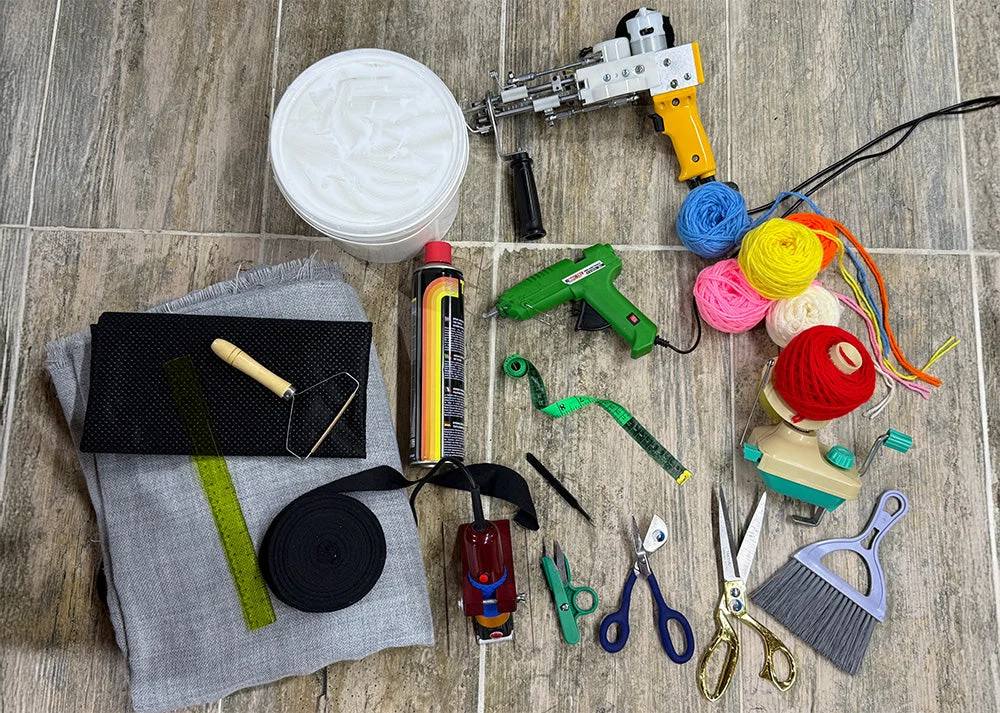
A few things worth knowing about monk’s cloth:
If you ever hear someone mention “primary cloth” or “primary backing” in the tufting world, they’re referring to the same category of fabric — different suppliers sometimes use slightly different terminology, but the function is the same.
Yarn is where the creative choices really live. Unlike backing fabric, which is fairly standardized, yarn comes in a wide range of materials, weights, and finishes — and the type you choose affects both how your finished rug looks and how it feels underfoot.
By far the most common yarn used in tufting workshops, and for good reason. Acrylic yarn is:
Wool is a step up in both cost and texture. It has a naturally soft, plush hand-feel and tends to hold its shape and colour well over time. Many people choose wool for statement pieces or gifts, since it has a more premium look and feel than acrylic. The tradeoff is cost and slightly more careful maintenance.
Yarn weight (how thick or thin the strand is) affects the texture of your finished piece:
For a first-time class, most studios use a consistent, beginner-friendly yarn weight so you’re not managing that variable on top of learning the tufting motion itself.
Beyond fabric and yarn, the style of tufting changes the texture of your finished rug significantly.
Cut pile uses a tufting gun that cuts the yarn as it’s punched through, leaving soft, fluffy strands standing upright — similar to a plush shag rug. This is the more common style for beginner classes because it’s forgiving and produces an immediately satisfying, textured result.
Loop pile leaves the yarn in uncut loops, creating a smoother, more structured surface — closer to a Berber-style carpet. Loop pile tends to be more durable underfoot and gives designs a cleaner, more defined edge, but it requires a slightly different gun technique.
Some tufted pieces combine both — using loop pile for outlines and cut pile for fill — to create texture contrast within a single design. This is a more advanced technique, but it’s worth knowing it exists if you ever want to push your second or third project further.
While the tufting gun isn’t a “material” in the traditional sense, it’s worth understanding briefly since it directly interacts with your fabric and yarn choices. The gun feeds yarn through the monk’s cloth at a controlled depth and speed, and different guns are calibrated for either cut pile or loop pile work (some newer models can switch between both). For a first-time class, you won’t need to worry about choosing or calibrating a gun yourself — your instructor handles setup — but understanding what it’s doing helps demystify the process.
Once the tufting itself is done, a few additional materials go into finishing the piece so it’s durable enough to actually use:
This finishing stage is what transforms a tufted piece from “yarn held in place by tension” into a genuinely durable rug or wall hanging that can handle regular use.
If you’re heading into your first session and wondering what’s realistically in front of you, here’s the short version: a pre-stretched monk’s cloth canvas on a frame, a curated selection of acrylic yarn colours, a cut-pile tufting gun, and finishing materials handled by your instructor at the end. You won’t need to source or bring any of this yourself — the appeal of a studio class over a DIY kit is that all of these material decisions are already made for you, so you can focus entirely on your design and technique.
Almost all rug tufting uses monk’s cloth, a loosely woven cotton fabric with a visible grid that helps guide your design and gives the tufting gun a stable surface to work with.
Acrylic yarn is the most common choice for beginners because it’s affordable, comes in a wide range of colours, and is durable enough for a finished rug that will actually be used.
Understanding the materials behind rug tufting doesn’t just satisfy curiosity — it makes your actual class experience smoother, since you’ll already understand why the fabric is stretched the way it is, why your instructor recommends a certain yarn weight for your design, and what’s happening when the gun punches through the cloth.
Once you’ve got the basics down, the best way to really understand them is to get your hands on a gun and try it yourself.