- 226-348-4177
- [email protected]
- 1315 Lawrence Ave E,unit 406, M3A 3R3, North York, Ontario

If you’ve been searching for a tufting class in Toronto, you’ve probably noticed the terms “carpet tufting” and “rug tufting” used almost interchangeably — sometimes even on the same website. So which one is it? Are they actually different crafts, or just two names for the same thing?
Here’s the short answer: in the context of a hands-on workshop, carpet tufting and rug tufting refer to the same technique. But the terms have slightly different histories and connotations, and understanding where they come from can help you search smarter and know exactly what to expect when you book a class.
The confusion mostly comes down to industry language versus everyday language.
“Carpet tufting” is the older, more industrial term. It originates from large-scale manufacturing, where tufting machines are used to mass-produce wall-to-wall carpeting for homes, offices, and commercial spaces. In this context, “carpet” refers to the continuous, room-sized flooring product — not the small, individual pieces people make in a workshop.
“Rug tufting” is the term that took off with the rise of the craft as a hobby and hands-on creative activity, especially once it went viral on social media. “Rug” better describes what people are actually making by hand: a standalone, often decorative piece — think a small area rug, a wall hanging, or a coaster — rather than continuous flooring.
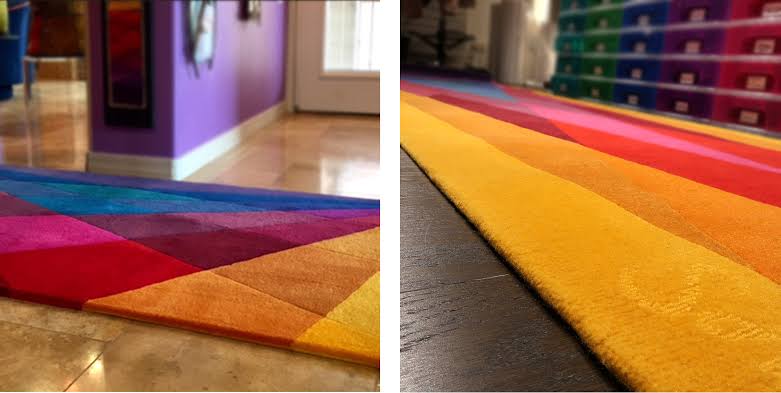
So technically, if you’re taking a class where you make a single, freestanding textile piece using a handheld tufting gun, you’re doing what most of the industry now calls rug tufting, even if some people still search for it as “carpet tufting” out of habit or because that’s the more familiar general term.
Whether someone calls it carpet tufting or rug tufting, the actual process doesn’t change:
There’s no separate skill set, tool, or technique that’s exclusive to one term over the other. If a studio advertises “carpet tufting workshops,” they are, in virtually all cases, teaching the exact same hands-on process as a studio that calls it “rug tufting.”
While the hands-on craft is the same, there are two contexts where the distinction matters more:
So if you ever come across the term “carpet tufting” in an industrial or flooring context, it’s referring to something quite different from what you’d be doing in a creative workshop — even though the underlying punch-needle technique has the same origins.
Not for finding a class — but it’s a useful thing to know if you’re comparison-shopping between studios online, since some businesses lean into one term for search visibility while functionally offering the same experience. If you see “carpet tufting Toronto” and “rug tufting Toronto” both coming up in your search results, don’t assume they’re different activities requiring different research. In almost every case, you’re looking at the same craft, just described with different, historically-rooted language.
If you book a class described as either carpet tufting or rug tufting, here’s what’s consistent across both:
Is carpet tufting the same as rug tufting? In the context of a hands-on workshop, yes — they refer to the same technique using a tufting gun to punch yarn through fabric. “Carpet tufting” is an older, more industrial term, while “rug tufting” is more commonly used for the modern hobbyist craft.
Why do some studios use the word “carpet” instead of “rug”? It often comes down to search habits and regional or generational language preference rather than any technical difference in the craft being taught.
Is there a tufting technique used only for carpets and not rugs, or vice versa? No — the fundamental technique (stretching fabric, tracing a design, using a tufting gun to fill it in, then finishing the back) is the same regardless of which term is used to describe the class.
Should I search “carpet tufting” or “rug tufting” to find a class near me? Either works, but “rug tufting” tends to return more results specific to hands-on beginner workshops, since it’s become the more commonly used term for the hobbyist craft in recent years.
Carpet tufting and rug tufting aren’t two different crafts — they’re two names for the same hands-on technique, shaped by different histories. Industrial carpet manufacturing gave the craft its original name, while the hobbyist, workshop version of tufting has largely adopted “rug tufting” as its modern identity. Whichever term brought you here, the experience waiting for you is the same: a beginner-friendly, hands-on session where you’ll walk away with a piece you made yourself.