- 226-348-4177
- [email protected]
- 1315 Lawrence Ave E,unit 406, M3A 3R3, North York, Ontario

You’ve seen the videos. Someone’s sitting at a big wooden frame, holding what looks like a power tool, pressing it into fabric, and out of nowhere a plush, colourful rug starts appearing. It looks satisfying. It looks accessible. It looks like the kind of thing you’d be good at.
And then you think: but what actually happens when you walk in? What if I’m terrible at it? What if I don’t know what design to make? Is it noisy? Is it physically hard? Will I finish? What do I actually take home?
These are the questions every first-timer asks before booking a rug tufting class in Toronto. And they’re the exact questions this post is going to answer — honestly, in order, without skipping the parts that other guides leave out.
We’ve taught over 1,200 people how to tuft at ZuoZuo Studio in North York. We know which worries are legitimate (a few), which ones evaporate within the first fifteen minutes (most of them), and which moments genuinely surprise people in ways they didn’t expect.
This is that guide. By the end of it you’ll know exactly what you’re booking, what to do before you arrive, what each stage of the session feels like, and what you’ll walk out with. No anxiety required.
Let’s make sure we’re on the same page about what the craft actually is, because a lot of first-timers arrive with slightly the wrong mental image.
Rug tufting is the process of creating a custom rug or wall hanging by pushing yarn through a stretched fabric backing using a handheld motorised tool called a tufting gun. The backing fabric — called monk’s cloth — is stretched tightly over a wooden frame. You load the gun with yarn, press its needle against the cloth, pull the trigger, and the gun rapidly punches loops of yarn through the fabric to build up a dense, plush pile on the front surface.
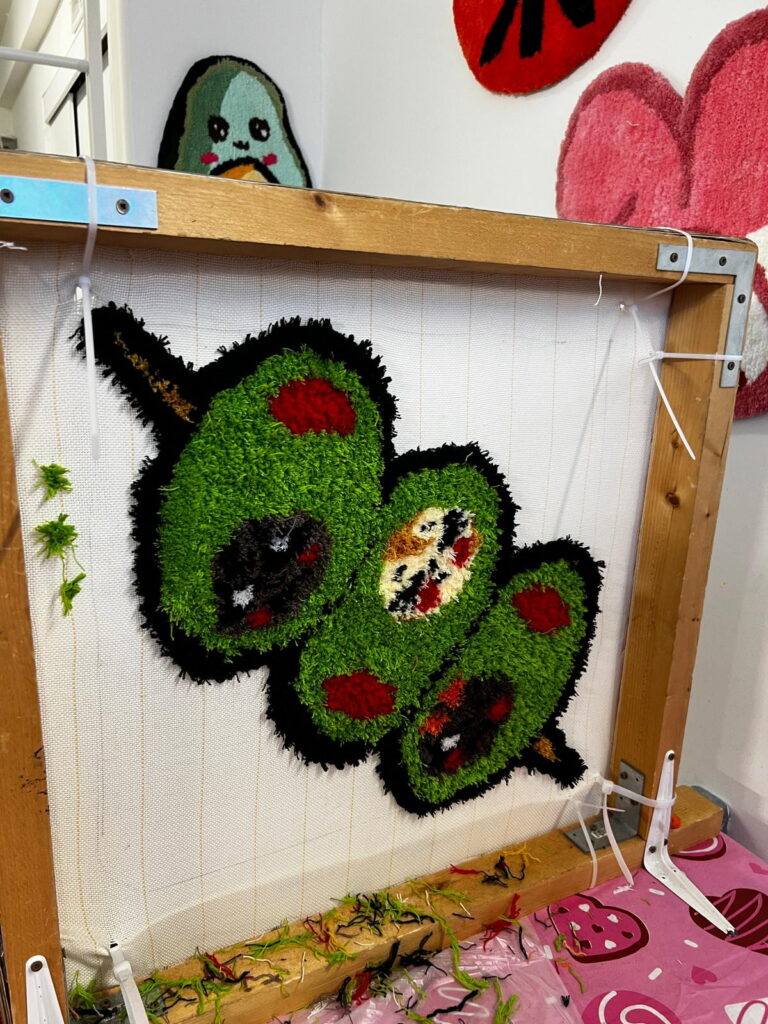


Think of it as painting with yarn. Your frame is the canvas. Your tufting gun is the brush. Your yarn colours are your palette. The design you choose — a geometric pattern, your initials, your dog’s face, a football flag, an abstract — becomes a physical, finished textile object.
Two pile styles exist:
Cut-pile: After tufting, the yarn loops are cut, leaving individual upright fibres. The result is a soft, plush, carpet-like texture — the classic rug feel. This is what most people picture when they imagine a tufted rug, and it’s the primary technique taught at ZuoZuo Studio.
Loop-pile: The loops are left intact rather than cut, producing a bouncier, more textured surface with a modern or Scandinavian quality. Some studios offer this as an option; ask when you book if you have a preference.
The gun does the vast majority of the work. You are guiding it, not fighting it. The physical effort involved is less than you’d think — more like sustained concentration than physical exertion, though your arms will know they were working by the end of a longer session.
The single most useful thing you can do before your first tufting class is decide — at least roughly — what design you want to make.
You don’t need a finished drawing. You don’t need design software. You don’t need artistic training. A reference image saved to your phone is enough. A rough sketch on a piece of paper is enough. Even a clear verbal description — “I want something geometric in blue and orange” or “I want to tuft my cat’s face” or “I want the Canadian flag but more colourful” — is enough. The instructor at ZuoZuo will help you translate whatever idea you have into something achievable within your session time and rug size.
What helps versus what doesn’t when choosing a first design:
Works well for beginners:
Harder for first-timers (not impossible, just slower):
The most consistent advice from people who’ve done it: start slightly simpler than you think you need to, because the work of tufting itself is engaging enough that you don’t need the added pressure of a complex design. Many people describe their “simple” first rug as the one they’re most proud of — because the quality of the tufting itself becomes the thing people notice, not the sophistication of the design.
Other things to do before you arrive:
Choose your rug size when you book. ZuoZuo offers small (50×50 cm), medium (70×70 cm), large (90×90 cm), and XL. For a first session, the medium is the most popular choice — large enough to do something genuinely interesting, manageable enough to finish comfortably in one afternoon. The small is a great choice if you’re short on time or genuinely unsure whether tufting is for you. The large and XL are for people with a specific ambitious design or groups working together on one piece.
Wear comfortable clothes. Yarn fibres float in the air during tufting — not heavily, but enough that you’ll want to be wearing something you don’t mind getting a strand or two on. Closed-toe shoes are slightly more comfortable than sandals for standing at the frame for 2–3 hours, but either is fine.
Eat beforehand. Not because tufting requires enormous physical energy, but because sessions run 2–4 hours and focused creative work makes you hungry. ZuoZuo’s BYOB policy means you can also bring drinks — a coffee, a kombucha, a glass of wine with a date night booking. Many groups treat the session as an afternoon out and pack accordingly.
This is the part most first-timers are most nervous about, and the part that most consistently resolves faster than expected.
You arrive at ZuoZuo Studio at 1315 Lawrence Ave E, Unit 406, North York. The studio is warm and visually lively — yarn in every colour, frames with works in progress, rugs finished and hanging on the walls. It doesn’t feel clinical or intimidating. It feels like someone’s very well-equipped creative workshop.
You’re greeted by your instructor, shown around, and brought to your station. Your frame is already set up — monk’s cloth pre-stretched, tight and ready. This is one of the parts that surprises first-timers most: the preparation work (stretching the cloth, setting up the frame) is already done for you. You sit down to a clean, ready canvas.
The first conversation is about your design. If you’ve come with an idea, this is when you share it. Your instructor will look at your reference image or sketch, assess what’s achievable in your session time, and help you refine it if needed. If you’ve come without any idea, you’ll be shown options at different complexity levels and helped to choose something that fits both your vision and your timeline. This step typically takes 10–20 minutes, and it’s worth taking seriously — the quality of a tufting session is substantially determined by the quality of the design decision made at the start.
Your design gets traced or projected onto the monk’s cloth. You choose your yarn colours from the studio’s full selection — this is usually the moment people start to get genuinely excited, because holding 50+ colours of soft, vibrant yarn and choosing which ones become your rug is unexpectedly satisfying. Most first-timers start conservatively and then go back for more colours once they see how the sections look together.
Let’s be honest about this, because several other guides aren’t.
The first fifteen to twenty minutes of tufting are slightly awkward. Not difficult, not discouraging — just unfamiliar. You’re holding a tool you’ve never held before, working with a material that behaves in ways you haven’t learned yet, and trying to stay on the lines of a design while getting used to the gun’s speed and resistance.
Specifically, here’s what feels strange at first:
Pressure and angle. The tufting gun needs to be held at approximately 90 degrees to the frame and pressed firmly against the cloth to fire properly. Too light and the yarn doesn’t punch through. Too hard and you’re fighting the frame. The right pressure is in between, and it takes a few minutes to find.
Speed control. The gun has a trigger that controls how fast it fires. Going too fast in the early stages makes it harder to follow your design lines accurately. Most instructors recommend starting at a medium speed and adjusting as your confidence grows.
Corners and curves. Straight lines are easy. Corners and curves require slowing down, lifting the gun, repositioning, and continuing — a stop-start rhythm that feels choppy at first and becomes instinctive quickly.
Yarn tension. Occasionally, the yarn doesn’t feed smoothly and a loop pulls out of the cloth. This is normal, not a disaster. Your instructor will show you how to fix it — it takes about ten seconds.
All of this sounds like a lot on paper. In practice, the instructor is with you for the entire early stage, correcting your grip and angle in real time, showing you how to handle corners, and making sure you’re comfortable before stepping back. By the twenty-minute mark, the overwhelming majority of first-timers have found their rhythm. The awkward phase is short.
This is the part the videos capture and the part that brings people back.
Once the initial learning curve resolves — usually somewhere between twenty and forty minutes in — something shifts. The technique stops being something you’re thinking about and becomes something you’re just doing. Your hands know the pressure and angle. Your eyes are on the design. The gun’s sound becomes background noise rather than a thing you’re monitoring. You’re filling in a section of your rug, and your attention is on the colour, the pattern, the shape emerging in front of you.
This is the state most people describe as the most surprising part of tufting: how completely it absorbs you. Focused creative work with a rhythmic physical component produces something close to a flow state — the specific quality of attention where time passes differently, where the mental chatter that normally runs in the background of a busy Toronto week goes quiet, and where you surface an hour later not quite sure where the time went.
It’s genuinely meditative in a way that’s different from activities that are sold as meditative but require you to sit still and think about your breathing. Tufting gives your hands something to do, your eyes something to track, and your mind something to engage with — and the combination of those three things produces the quiet. Research from the University of Toronto found the rhythmic motion of tufting reduces cortisol by 28% in under twenty minutes. If you’ve spent any amount of time in a tufting session, that statistic feels immediately credible.
During this phase, your instructor circulates. They’re not hovering — they’re checking in, offering guidance when you hit a tricky section, suggesting colour adjustments, and answering questions as they come up. The atmosphere in the studio during active tufting is warm and conversational rather than silent and focused. People talk to each other. Groups laugh. Couples compare sections of their designs. The social energy is real and easy, which is part of why tufting works so consistently well as a date night or group activity.
When your design is fully tufted — every section filled in, the whole canvas covered — you move into the finishing stage. This takes approximately 20–30 minutes and turns the tufted canvas into a finished, usable rug.
Here’s what happens:
Applying the backing glue. Latex glue is spread evenly across the back of the tufted canvas. This locks every yarn loop permanently in place — the glue is what prevents the tufting from pulling out over time and what gives the finished rug its durability. A well-glued tufted rug lasts 10–25 years with normal use.
Trimming the pile. The front surface of a freshly tufted rug is slightly uneven — some loops sit higher than others depending on the angle and speed at which they were punched. Your instructor trims the pile to a consistent height using scissors or a trimmer, which transforms the texture from rough to smooth and the colour from slightly dull to vivid. This step is the one that most consistently produces the “oh” moment — the moment the rug stops looking like a work in progress and starts looking like a finished object.
Attaching the backing fabric. A felt or canvas backing is applied to the glued surface, giving the rug a clean underside that protects both the floor and the rug itself. This is what makes the finished piece feel like a proper textile rather than a craft project.
Final inspection and roll. Your instructor does a final check, trims any stray fibres, and rolls the rug for carrying. You leave with it.
A finished rug. Not a half-finished project to complete at home. Not a kit. Not something that needs to dry for three days. A finished, rolled, ready-to-use rug that you designed, tufted, and finished in a single afternoon in North York.
This is the part that catches first-timers off guard in the best possible way. The gap between “I’ve never done this before” and “I am now carrying a handmade rug that I made” is shorter than almost any other craft experience in the city.
What people do with their rugs varies as much as the designs themselves. Some go on living room floors. Some hang on walls. Some sit on entryway benches. Some become the thing guests ask about every time they visit, and the owner gets to say — with complete accuracy — “I made it at a studio in North York.” Some become gifts. Some become the first in a collection.
The medium size (70×70 cm) is the most versatile — substantial enough to display properly, small enough to carry home on the TTC without hassle. The large and XL are better suited to people with a specific home décor vision or groups who want to produce something that becomes genuinely central to a room.
Will I be able to finish in one session? Yes, within your booked size. Sessions are structured to ensure you finish. The small (50×50 cm) typically takes 1.5–2 hours. The medium (70×70 cm) typically takes 2.5–3.5 hours. The large (90×90 cm) runs 4–5 hours. Choose your size based on how long you want to spend, not on ambition — a well-made small rug is more satisfying than a rushed large one.
What if I hate my design halfway through? Raise it with your instructor as soon as you feel it. Mid-session adjustments — adding colours, modifying sections, shifting the focus of the design — are possible and much easier to do while you’re still tufting than after the glue goes on. Instructors would rather you speak up at the 45-minute mark than stay quiet and leave disappointed.
Is it noisy? The tufting gun makes a consistent mechanical sound — similar to a sewing machine. In a studio with multiple people tufting simultaneously, the ambient sound level is noticeable but not uncomfortable. If you’re sensitive to noise, ear protection is available and there’s no social awkwardness in using it.
Is it physically tiring? Your arms and shoulders will feel it after a longer session — holding a tool at a consistent angle for 3–4 hours engages muscles you don’t usually use. Several regulars describe it as an unexpected arm workout. Taking short breaks, especially during XL sessions, is encouraged and normal.
What if I’m not artistic? Tufting does not require artistic skill. It requires the ability to follow lines and fill sections with colour, which is a mechanical task rather than a creative one. The creative decision — what to design — happens at the beginning, and you’re fully supported in making it. Once the design is on the canvas, the work is execution rather than artistic judgement. People with no artistic background consistently produce pieces they’re proud of.
Can I come back and do it again? Yes, and many people do. Returning visitors typically choose a larger size and a more complex design than their first session. The learning curve on the second visit is essentially zero — the technique is already in your hands, and you can focus entirely on the design and the making.
Studio address: 1315 Lawrence Ave E, Unit 406, North York, ON
Hours: Thursday – Sunday, 12pm – 8pm
TTC: Take Line 1 to Lawrence Station, then the 54 Lawrence East bus eastbound. Approximately 10–12 minutes from Lawrence Station. Also accessible via the Eglinton Crosstown LRT at Lawrence East station.
Parking: Available in the building.
Pricing:
What’s included: Frame, monk’s cloth, tufting gun, full yarn colour selection, glue, backing material, instructor guidance, and the finished rug. Everything.
BYOB: Welcome.
Booking: Online at zuozuostudio.ca. Walk-ins are not available. Weekend sessions book 2–3 weeks in advance in summer — book early.
Accessibility: Wheelchair accessible. Contact the studio in advance for specific accessibility requirements.
Phone: 226-348-4177 Email: [email protected]
Here is the most honest summary of what your first rug tufting class in Toronto will be like:
The first fifteen minutes will feel slightly unfamiliar. By thirty minutes in, you’ll have found your rhythm. By the halfway point of your session, you’ll be absorbed in a way you didn’t expect. By the end, you’ll be holding something you made — a finished, real, handmade rug — and wondering when you can come back to make the next one.
That’s the experience. It’s consistent enough across the 1,200+ people who have come through ZuoZuo Studio that we can say it with confidence: the worry you have right now, sitting at your phone or laptop deciding whether to book — it evaporates within twenty minutes of picking up the gun.
Book your first class. Come make something.
👉 Book your first rug tufting class at ZuoZuo Studio →
📍 1315 Lawrence Ave E, Unit 406, North York, ON 🕐 Thursday – Sunday | 12pm – 8pm 📞 226-348-4177