
Nuit Blanche Toronto 2026 runs from 7pm Saturday, October 3 through 7am Sunday, October 4 — a free, all-night celebration of contemporary art that turns public spaces across the city into open-air galleries until sunrise. This year marks the event’s 20th anniversary, with the theme “Tomorrow’s Memories,” looking back at two decades of installations, artists, and venues that have defined the festival since it began in 2006.
If you’ve never been: this isn’t a gallery crawl with fixed hours. It’s a genuine all-nighter — nearly 100 contemporary art projects spread across the city, running from sunset straight through to sunrise, free to attend, with past editions drawing well over a million attendees citywide.
Nuit Blanche (“white night,” or “sleepless night,” in French) originated in Paris before Toronto adopted the format in 2006. Since then, it’s featured roughly 1,800 art installations from about 6,350 artists, and the City of Toronto estimates the event has generated over $550 million in economic impact for the city over its run. It’s produced by the City of Toronto in collaboration with the local arts community, with locations, curation, and artists changing every single year — no two editions look alike.
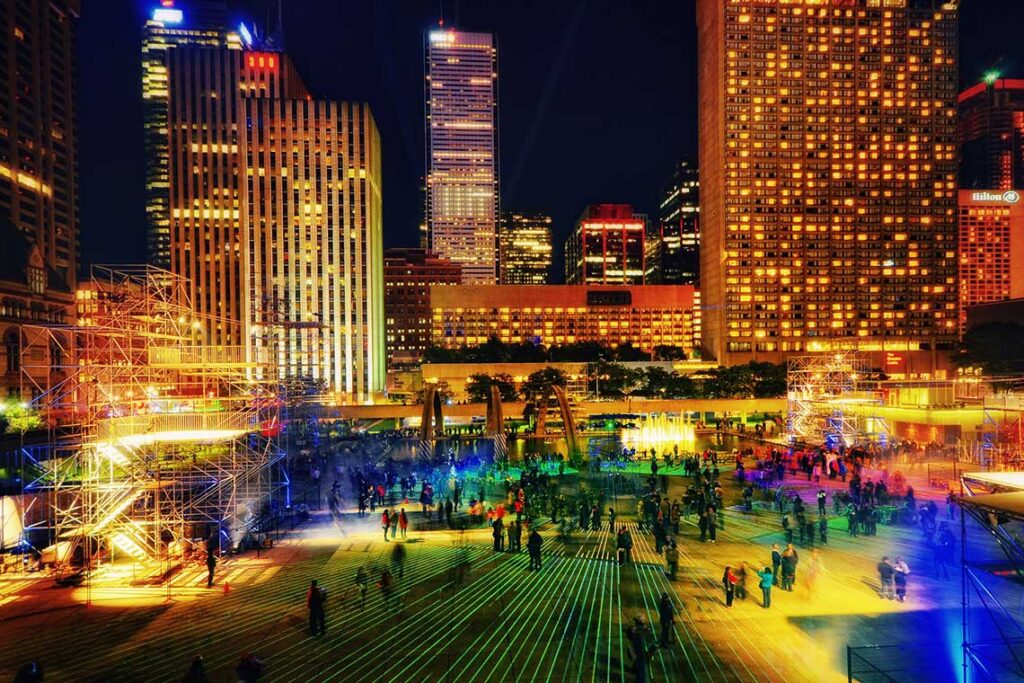
The scale is genuinely different from a typical gallery night. Past editions have featured names like Director X, Daniel Arsham, Esmaa Mohamoud, and Bryan Espiritu, alongside hundreds of emerging and independent artists working across every discipline. Expect neon installations, projections, interactive works, live performance art, and site-specific pieces that transform bridges, underpasses, storefronts, and public squares — not just traditional gallery spaces. Past themes have ranged widely: 2024’s edition, for instance, was built around “Bridging Distance,” exploring how physical and social distance shows up in bodies, cities, and relationships. Every year reinvents the format around a completely different curatorial question.
For the 20th anniversary, the 2026 theme reflects on the festival’s own history — looking back at the artists, curators, communities, and venues that have defined Nuit Blanche over two decades, while also looking ahead. Many installations from past years no longer exist except as memory: some featured artists are no longer living, some venues have closed or moved, and new spaces have emerged in their place. This year’s programming revisits and recontextualizes that history alongside entirely new work responding directly to the theme — less a straightforward retrospective than what the organizers describe as both “a reckoning and a reimagining” of where the event has been and where it’s headed next.
Nuit Blanche installations spread across multiple hubs throughout the city rather than concentrating in one spot — past editions have run simultaneously through downtown, Scarborough, Danforth East, and other neighbourhoods, each with its own curatorial focus. Nathan Phillips Square is traditionally one of the anchor locations, and 401 Richmond — a well-known creative hub in the Fashion District — is confirmed running its own dedicated programming this year, with two floors of exhibitions, installations, and performances from 7pm to 7am. Toronto’s major museums and galleries also typically host exclusive, one-night-only exhibitions and pop-ups as part of the broader event.
Because locations and specific installations are announced closer to the date and change year to year, check the City of Toronto’s official Nuit Blanche page (toronto.ca) in the days before the event for a confirmed map and installation list.
This is the part first-timers most often get wrong: you cannot treat this like a normal Saturday night out. The city plans around it, and you should too.
The TTC runs subway service all night. In past editions, Line 1 (Yonge–University) and Line 2 (Bloor–Danforth) have both stayed open through the night specifically for Nuit Blanche, with trains running roughly every 15 minutes through the overnight hours rather than the usual 1:30am closure — some years this has extended as far north as Finch. All subway stations stay open overnight for the event, and regular Sunday morning service picks up seamlessly afterward. Confirm the exact overnight coverage on ttc.ca in the days leading up to the event, since the specific extended zone has varied year to year.
Expect road closures. Past editions have closed sections of Queen Street West, Bay Street, Queens Quay, and Queens Park to create safe, walkable car-free zones around the busiest installation clusters. Don’t plan on driving directly to a downtown installation and parking nearby — build in a walk from wherever you can park, or skip the car entirely.
Biking is a genuinely good option. With car-free zones and the sheer distance between installations, cycling lets you cover more ground across the night than walking alone. Bike Share Toronto is a solid option if you don’t have your own bike — just bring a light, a bell, and a helmet, since you’ll be riding through the night.
GO Transit runs on its regular schedule, without the same overnight extension as the TTC subway — if you’re coming from outside the city, plan your return trip around GO’s normal hours rather than assuming all-night service applies system-wide.
Comfortable shoes. This is the single most repeated piece of advice from past attendees, for good reason — you’ll be on your feet moving between installations for hours, likely covering several kilometres over the course of the night.
Layers for October weather. Fall nights in Toronto can swing cold, especially in the small hours before dawn, for an event that runs well past midnight into sunrise.
A portable phone charger. Between navigating, photos, and staying in touch with whoever you’re with in a crowd, battery life goes fast on an all-night event.
Cash or a transit card loaded in advance, since fumbling with fare payment in a packed station at 2am is its own kind of stress.
With installations spread across the entire city, trying to see everything in one night is a losing game. Pick 2–4 “must-see” installations ahead of time — using whatever map the City publishes closer to the date — and build a loose route between them, filling in whatever else you stumble across along the way. This works far better than an unplanned wander, which tends to burn hours of walking without actually reaching the pieces you wanted to see most.
Several designated event hubs around the city typically offer maps, food vendors, washrooms, and first-aid support from Toronto Paramedic Services during the event — worth locating one near your planned route before you set out, rather than searching for one at 3am.
Some installations extend past the single night. In past years, a curated selection of projects has remained on view for over a week after the main event, so it’s worth checking the official listings after October 4 if you miss something — though extended viewing dates and hours vary by location and aren’t guaranteed every year.
Nuit Blanche runs straight through the night, so late-night food is part of the plan for a lot of attendees. If you’re near Scarborough-area installations, Chinese comfort food — congee, dumplings, noodles, spring rolls — is a reliably good after-hours option in that part of the city. In Trinity-Bellwoods, a well-known 24-hour diner in the neighbourhood serves a popular late-night and brunch menu, useful if you’re winding down as the sun comes up rather than heading straight home.
When is Nuit Blanche Toronto 2026? Saturday, October 3, 2026, from 7pm through Sunday, October 4 at 7am.
Is Nuit Blanche free? Yes — it’s a free, all-night public art event, open to everyone.
Is Nuit Blanche just downtown? No — installations spread across multiple hubs citywide, including Nathan Phillips Square, 401 Richmond in the Fashion District, and various museums and galleries, plus neighbourhoods like Scarborough and Danforth East in past editions. The specific locations and installation list are confirmed closer to the event date.
Does the TTC run all night during Nuit Blanche? Yes — in past years the subway (typically Line 1 and Line 2) has run all night specifically for the event, with trains roughly every 15 minutes, rather than the usual overnight closure. Confirm the exact coverage on ttc.ca closer to the date, since it varies year to year.
What’s this year’s theme? “Tomorrow’s Memories,” marking the event’s 20th anniversary and reflecting on two decades of Nuit Blanche artists, venues, and installations.
Do installations stay up after the one night? Some do — in past years, a curated selection of projects has remained viewable for over a week after the main event, though hours and dates vary by location and this isn’t guaranteed every year.
Is Nuit Blanche good for kids or families? It’s an all-ages, free event, though the all-night format and late crowds mean most families treat it as an early-evening visit rather than staying through to sunrise.
An all-night event like this takes real stamina, and a lot of attendees are wiped out by Sunday. If you want to build the rest of your October weekend around something calmer — or just don’t have the energy for a full sunset-to-sunrise night — pairing Nuit Blanche with a slower, indoor daytime activity the next day is worth considering. A hands-on studio session is a good antidote to an all-nighter: no crowds, no walking, just something to focus on while you recover.
📍 ZuoZuo Studio — 1315 Lawrence Ave E, Unit 406, North York 🕐 Thursday–Sunday, 12pm–8pm 🌐 Book a session
Guide current as of September 2026. Installation locations, transit details, and road closures are confirmed by the City of Toronto and TTC closer to the event date — check toronto.ca and ttc.ca before you go.